
Short-Term Rentals Are Not A Budget Solution, Should Be Unwelcome in Hoboken
While the last few weeks have seen multiple news reports about potential new regulations for short-term rentals (STRs) coming to Hoboken, we have yet to see much public action from the City Council or Mayor Jabbour. There have been zero public meetings and no STR-related agenda items at Council meetings. This week’s meeting (April 22) has one, but it merely authorizes the city to solicit quotes for STR registration and permitting services, seemingly in preparation for an ordinance to be proposed at a future meeting. While few details about this future ordinance have been shared with the public, the basic contours of it appear to be: a ban on the use of rent-controlled apartment units for STRs, and a registration and permitting system required for their use in ‘market rate’ apartments and single-family homes (including condos).
Hoboken United Tenants welcomes the (long overdue) ban on STRs in rent-controlled units. However, we do not feel the regulations described above go far enough, and instead call for a full ban on full-home short-term rentals, allowing them only in cases where the owner is home and rents a spare bedroom to a short-term guest. We have arrived at this position via a discussion of both the persistent issues caused by short-term rentals and the regulatory reality in Hoboken, as well as the results of a recent survey we circulated to Hoboken tenants (you can still fill it out here!).
Short-Term Rentals Make Life Harder for Hoboken Tenants
As any Hoboken resident can tell you, rental housing is in short supply. Allowing short-term rentals takes units off the market that would otherwise go to Hoboken residents. Banning STRs in rent-controlled units mitigates this issue somewhat as they can no longer be used to skirt tenant-friendly regulations, but market-rate units are still part of the local housing supply, and should go to local residents. Our survey identified persistent use of STRs in some market-rate buildings, with a few recently-constructed buildings (including at least one with a PILOT agreement!) essentially acting as illegal hotels. In the middle of an affordability crisis, these units should not be reserved for tourists.
In addition to restricting the supply of rental housing, STRs are a nuisance to neighbors. A major theme of the responses to our survey was an uneasiness with having strangers in the building, and we also received many reports of STR tenants being loud and disruptive, and abusing building amenities. Needless to say, this is not a problem that can be solved with a partial ban. Tenants deserve peace and quiet irrespective of the rent-control status of their building, and it’s hard to see how permits will alleviate safety concerns.
Regulatory Realism
Another reason we prefer a full ban on STRs is that we do not have faith that the city’s Division of Housing will be willing or able to enforce a multi-tiered system, where STRs are banned in some units but permitted in others, possibly with further nuances related to available days and owner presence (as we have seen in other cities).
The current state of rent-control enforcement in Hoboken is, to be kind, quite poor. Every rent-controlled unit in the city is supposed to be registered with the Rent Leveling Department each year. HUT estimates that this simple policy has around 25% compliance. It is likely that many Hoboken tenants are paying illegally high rents, but they are left to figure this out for themselves as the city does not do any proactive enforcement. Additionally, the city’s anti-warehousing ordinance (which prohibits landlords from holding vacant units off-market for an extended period) has been unenforced for decades. Through HUT’s organizing in Marineview Plaza, we have identified roughly 10% of that crucial affordable housing stock being illegally warehoused. There are surely many other warehoused units throughout the city.
Given all this, we feel that any STR regulation needs to be as simple and one-size-fits-all as possible. Different regulations for different units creates room for interpretation, and historically that kind of discretion has led to widespread non-compliance.
Short-Term Rentals Are Not A Budget Solution
Finally, there is an important budget aspect to all this. As you likely already know, Hoboken is facing a $17M budget deficit, and is searching for ways to avoid increasing property taxes or cutting crucial services. At least some of the City Council sees STR permitting and registration as a partial solution, as it will allow the city to levy a hotel tax on the short-term rentals. Councilman Quintero, in an interview with Gothamist a few weeks ago, said that ‘’[the hotel tax] is a revenue source that we can and should avail ourselves of if we have the opportunity.”
In an era of rising costs and tight municipal budgets, it’s easy to see how an STR tax would be irresistible. But how much would it actually raise? HUT did our own estimate, and found the answer to be: not much. While the available data is not perfect, our best guess is that a 3% tax on STRs would yield around $650,000 per year (you can see our calculations in the appendix below).
Hoboken does not need new housing ordinances to generate revenue- we simply need to enforce what is already on the books. If the city could achieve 100% compliance in rent-control registrations (and collected the $50 per unit that comes with it), it would generate almost as much money as a potential STR tax.
The real opportunity lies in warehousing enforcement. Every day that a unit is warehoused carries a fine of up to $500. Even if the city did not pursue the maximum penalty in all cases, HUT estimates that warehousing fines could generate over $3 million per year. That is five times as much as a short-term rental tax, and would reduce the city’s budget deficit by 20%. It would also come with the added benefit of incentivizing more rental units to be brought to market, while legalizing short-term rentals has the opposite effect.
The city does not need to cater to landlords to fix its budget. It can invest in enforcement to protect tenants and raise revenue at the same time.
Appendix-
Estimating Potential Revenue Sources
Short-term rental tax
Using data from AirDNA, we can come up with a rough estimate of how much total short-term rental (STR) revenue is generated in Hoboken per year.
Available properties: 722
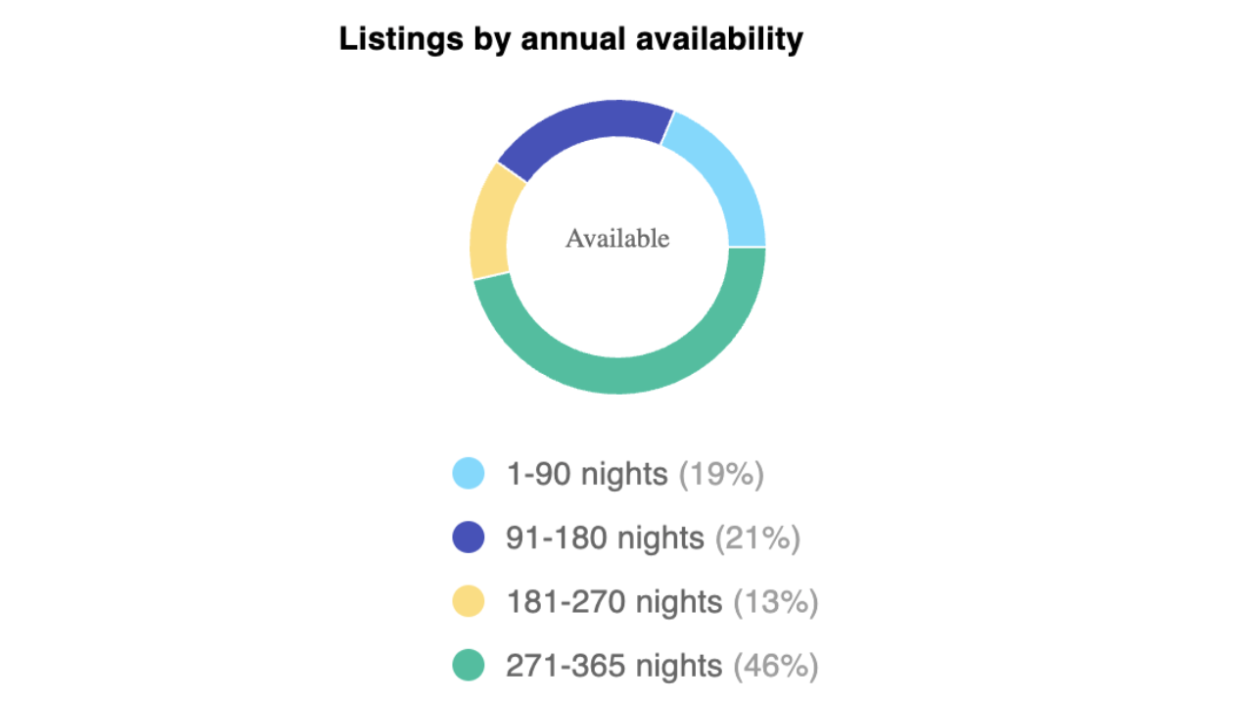
Average days available per property per year: 242*
Occupancy rate: 67%
Average daily rate: $279.60
Multiplying the number of total STR properties in Hoboken (722) by the average number of days those properties are available per year (242) gives us 174,724 total rentable days per year.
However, just because a property is rentable does not mean it is rented. Hoboken has a 67% occupancy rate, so of those 174,724 rentable days, 117,065 days are actually paid for by STR customers.
At an average daily rate of $279.60, those 117,065 rented days yield a total of $32,731,396 in annual STR revenue in Hoboken.
However, before we calculate the potential tax revenue from STRs, we have to account for the fact that many current STRs (those in rent-controlled units) will be outlawed, so this $32 million figure is not actually our STR tax base.
Let’s assume one-third of existing STR revenue is made illegal by the new ordinance. That leaves $21,820,931 in yearly STR revenue. At a tax rate of 3%, that yields $654,628 annually for the city.
*Note: AirDNA does not provide the average number of available rental days, so we calculate a rough average based on the chart below. For the 1-90 nights category, we assign a value of 60 nights. For the 91-180 nights category, we assign a value of 150 nights. For the 181-270 nights category, we assign a value of 240 nights. We assume that all properties in the 271-365 nights category are available year-round.
Warehousing enforcement
The Census Bureau’s American Community Survey estimates 18,607 rental units in Hoboken. It also estimates a 5.1% vacancy rate, leaving us with 948 vacant units.
Some of these are actively for rent, and so cannot be considered warehoused. HotPads lists 558 units for rent in Hoboken (Zillow lists 378, but we will take the higher number to give landlords the benefit of the doubt). This leaves us with 390 units being held off the market.
City code 154-5 details a process by which landlords may obtain a waiver to legally hold a vacant property off the market. Let’s assume that 50% of these vacant units are being held off the market for a valid reason (likely a generous assumption). That leaves us with 195 warehoused apartments.
Let’s also assume that each of these apartments is warehoused for 180 days per year. That leaves us with a total of 35,100 warehoused days per year.
Chapter 154 allows the city to levy a fine of up to $500 per vacancy per day. That gives us a total potential revenue of $17,550,000. If we assume (probably realistically) the city will not always pursue the maximum penalty and charges, on average, $100 per vacancy day, that still generates revenue of $3,510,000.
